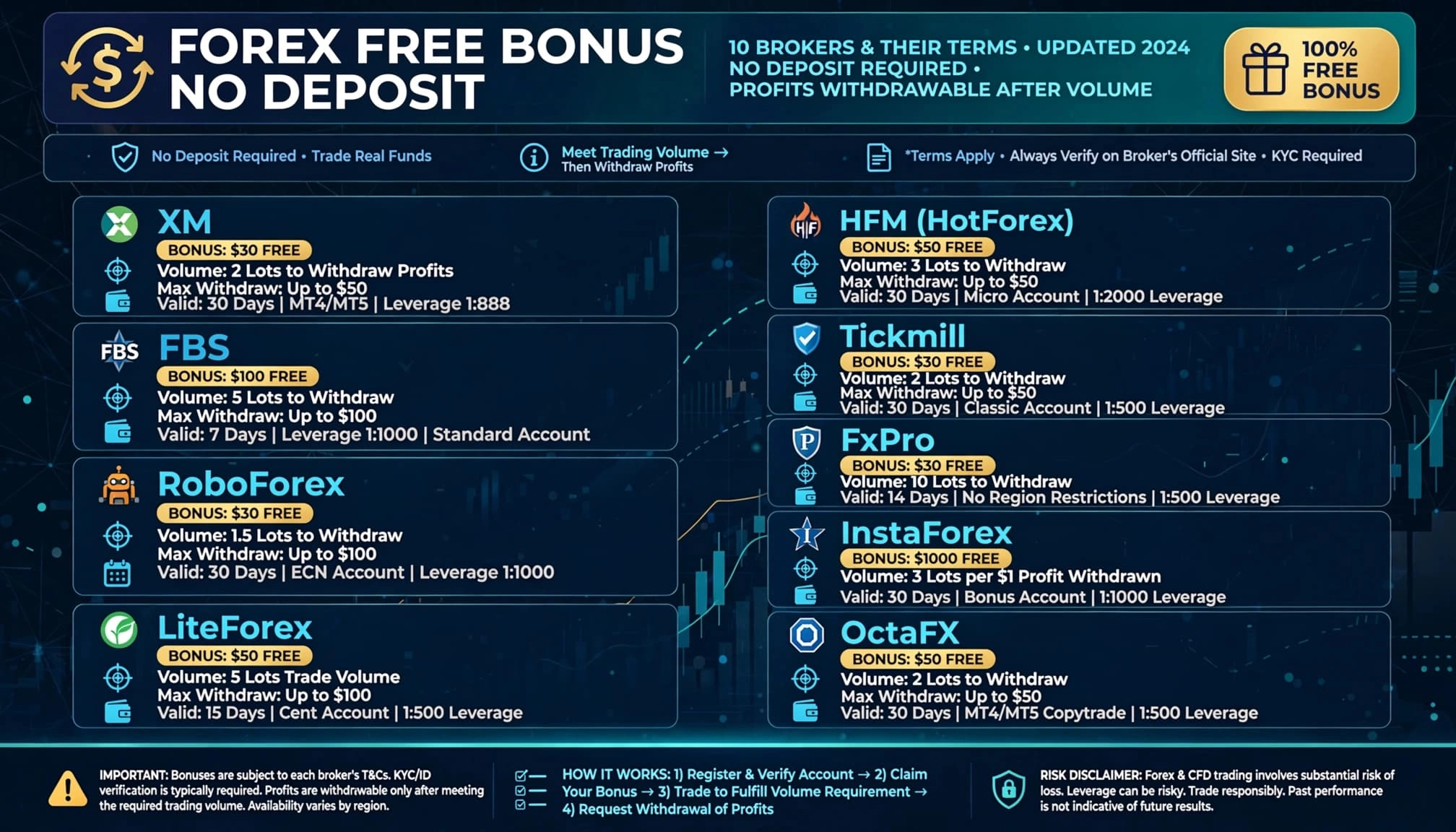

New no deposit bonus offers are coming soon. Please check back later.
A forex no deposit bonus is free trading credit: you trade live prices, but the credit itself is rarely withdrawable.
Profit you make can be withdrawn after you meet the broker's volume, verification and time rules.
Check three numbers first: required lots, profit cap and expiry date.
Small positions and a firm stop-loss turn a bonus into a skill-building account.
Forex New Promotion
See the bonus as a broker audition, run the numbers before you claim, and follow a 30-day plan that turns free credit into withdrawable profit.
forexallbonus.com sits in a popular corner of retail trading: forex no deposit bonuses. These offers promise a small amount of trading credit (or bonus funds) from a broker without paying first. That simple pitch attracts beginners, bonus hunters, and anyone who wants to test a broker with low risk.
This list breaks down what a site like https://forexallbonus.com/ is usually used for, what people focus on when comparing offers, and how no-deposit deals work in real life. Expect plain talk, common terms, and the details that often decide whether a bonus feels worth your time.
👉Forex Special Bonus Offer details in one place, see how to claim, key terms, and eligibility so you can start trading with a clear plan.
The main value of a directory-style site is convenience. Instead of searching broker by broker, readers get a page that’s focused on no deposit bonus forex brokers and related promos.
People usually come for speed: they want to see what’s available right now, then compare the basic conditions side by side.
Many broker promos sound similar, but the funding rules change everything. A true no deposit bonus doesn’t require an upfront payment, while a deposit bonus does.
Sites focused on no-deposit promos usually help separate these categories, so readers don’t waste time on offers that don’t match what they want.
“No deposit” sounds like “free money,” but brokers rarely treat it that way. In most cases, the bonus acts as restricted trading credit, not cash you can withdraw right away.
A useful bonus listing highlights whether profits can be withdrawn, whether the bonus itself is withdrawable, and what steps unlock withdrawals.
Most readers want the quick facts first. The typical essentials include the broker name, the bonus amount, eligible regions, and whether the offer is time-limited.
That short summary matters because bonus terms can be long, and people prefer to shortlist offers before reading the fine print.
A $50 no deposit bonus can be harder to cash out than a $10 one. Many offers come with trading volume targets, time limits, and limits on what profits count.
When people compare promos, the withdrawal conditions often matter more than the bonus amount. The “best” offer is usually the one with realistic rules.
No-deposit promos are often linked to a specific account type. Some brokers place bonuses on standard accounts, others require a “bonus account,” and some restrict it to cent accounts.
The account type affects spreads, commissions, minimum lot sizes, and how quickly volume requirements can be met.
Many promos only apply if the account uses a certain platform, often MetaTrader 4 (MT4) or MetaTrader 5 (MT5). Some brokers exclude bonus use on certain platforms or apps.
This matters because platform choice affects order types, chart tools, and even available instruments, which changes how the bonus can be used.
Some brokers limit no-deposit trading to a short list of instruments, often major forex pairs. Others allow metals, indices, or crypto, but place higher margin rules or tighter limits.
A bonus listing is most helpful when it makes these restrictions easy to spot, since “tradable instruments” can change the whole feel of the offer.
Most no-deposit bonuses focus on profit withdrawal, not bonus withdrawal. Brokers commonly require identity checks, minimum profit thresholds, and a trading volume target before any withdrawal request is approved.
Some also cap the maximum withdrawable profit from a no-deposit offer. That cap can turn a “big win” into a smaller payout on paper.
Volume targets are usually written in lots, not dollars. The lot requirement might be fixed (example: 5 lots) or tied to profit (example: X lots per $1 profit).
A key detail is how a broker counts volume: round-turn vs one-way, which instruments qualify, and whether partial lots count the same.
Many no deposit bonuses come with a deadline. It might be 7 days, 30 days, or a set time from account approval.
Time limits change behavior fast. A short window can push traders into higher risk, while a longer window makes the bonus feel more like a real test drive.
Most brokers require identity verification at some point. Some require it before granting the bonus, others only require it before withdrawal.
This is a big friction point for users. A clear bonus page usually points out whether KYC is needed upfront, plus what documents are commonly accepted.
No-deposit offers often vary by region due to regulation, marketing rules, or broker policy. The same broker may show different promos depending on where the user lives.
That’s why readers pay attention to “eligible countries” notes. It saves time and avoids signup paths that end in rejection.
Even when a deposit isn’t required, brokers can still set conditions like phone verification, email verification, or a unique device requirement.
Some also limit promos to one per household, one per IP, or one per payment method later on. Those rules are usually written under anti-abuse terms.
Brokers protect promos with strict terms. These often cover multiple accounts, matched hedging, using copied IDs, or trading patterns that look like bonus exploitation.
Even honest users can get caught by vague rules if they don’t understand them. That’s why promo listings that summarize “key restrictions” tend to be more trusted.
The bonus amount is only one piece. Trading costs decide whether a small balance can survive long enough to meet requirements.
High spreads can drain a no-deposit account quickly. Swap (overnight fees) can also matter if trades are held for days.
Small bonuses often come with small account balances, so the minimum lot size matters. If the broker forces a higher minimum trade size, risk rises.
Some brokers also cap the number of open trades or total lot exposure while using a bonus. Those caps affect strategy options.
No-deposit bonus accounts can have different margin rules than regular accounts. A higher stop-out level means positions close sooner when the market moves against them.
Leverage might also be limited on bonus accounts, which reduces flexibility but can lower blow-up risk.
Most people don’t withdraw huge money from a no-deposit offer. The structure is usually built for testing the broker, practicing execution, and learning the platform under live conditions.
When withdrawals do happen, they often look like small, capped amounts that depend on meeting clear steps. That’s not a flaw, it’s how most brokers keep promos sustainable.
Readers trust a promo directory when the info is easy to verify. Clear dates, direct broker naming, and simple summaries of key terms help.
People also pay attention to whether the site updates old offers, removes expired promos, and avoids hype language that doesn’t match broker terms.
No-deposit bonuses appeal to beginners because they lower the barrier to entry. They also appeal to experienced promo hunters because the rules are familiar and the comparison process is quick.
Forex no deposit bonuses look simple, but the details decide everything. Bonus amount, platform, tradable instruments, time limits, volume targets, and withdrawal caps all shape the real value.
A directory like .com is most useful when it helps readers compare those details fast, so they can understand what each offer is and what it isn’t.
A forex no deposit bonus is promotional trading credit a broker adds to a new live account without asking you to deposit money first. You trade real market prices with it, and profits become withdrawable once you meet the broker's conditions.
Usually the bonus credit itself cannot be withdrawn. The profit you make with it can be, after you complete the required trading volume, verification and any minimum activity rules. Most brokers also cap the maximum profit you can cash out.
It costs you no money, but it is not unconditional. You pay with time, identity verification and trading volume. Read the terms so you know the lot requirement, expiry date and withdrawal cap before you place a trade.
It is a customer acquisition tool. Brokers let you test their platform, execution and support at no cost, hoping you will become a funded client later.
Almost always. Most offers require a verified identity document and proof of address, and some also verify your phone number. Verification protects the broker from duplicate accounts.
Realistic results are modest. Withdrawal caps commonly range from a few dozen to a few hundred dollars. Treat the bonus as a low-risk way to build skill and test a broker, not as a source of large income.
You can claim offers from different brokers, but each broker normally allows only one bonus per person, household, IP address or device. Opening duplicate accounts usually voids the bonus and any profits.
A no deposit bonus requires no funding and is small. A deposit bonus is a percentage added on top of money you deposit, so it can be larger but puts your own capital at risk.
Tell us your bonus or promotion FOR FREE. It is easier than you think!