
New no deposit bonus offers are coming soon. Please check back later.
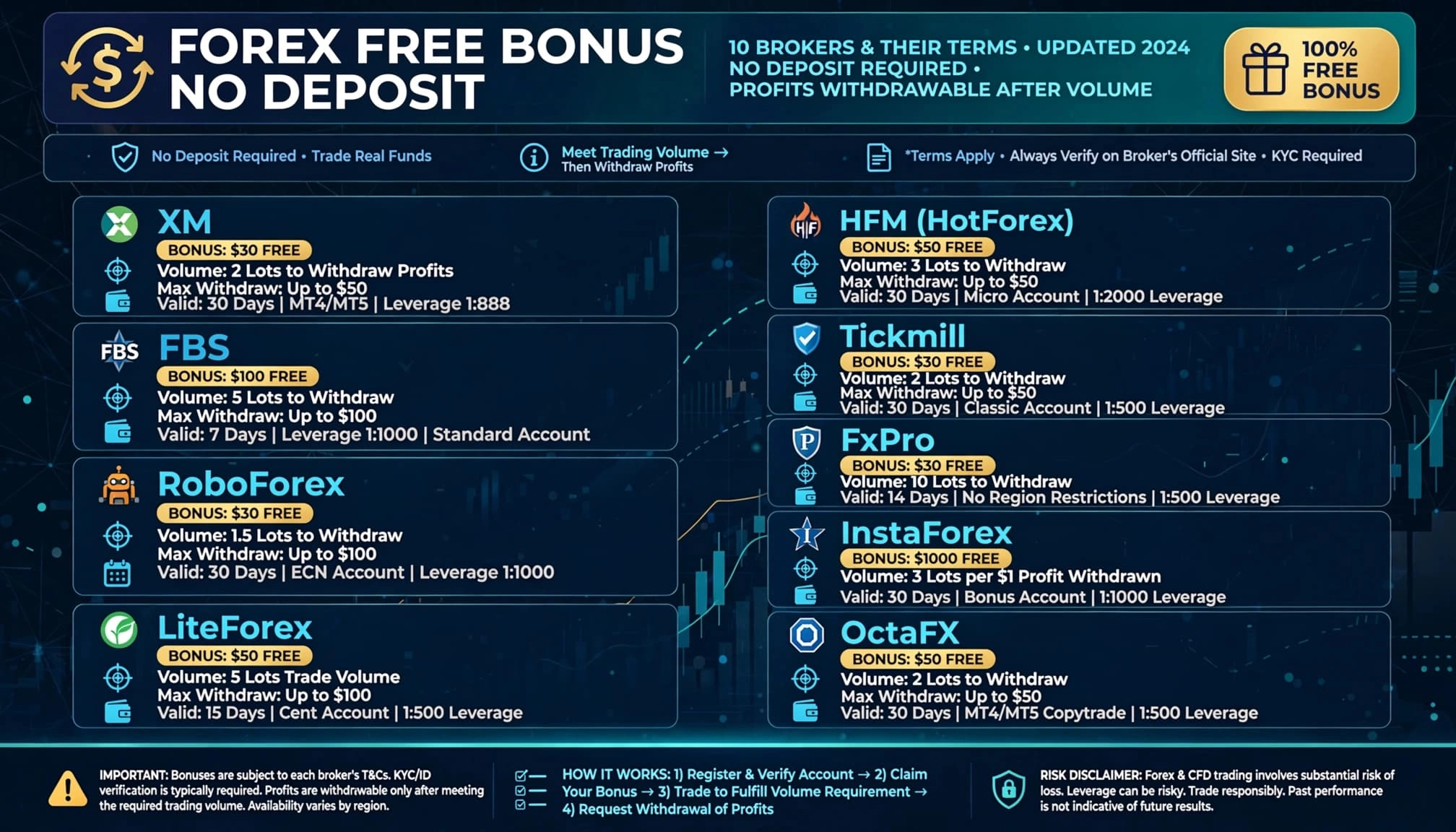
A forex no deposit bonus is free trading credit: you trade live prices, but the credit itself is rarely withdrawable.
Profit you make can be withdrawn after you meet the broker's volume, verification and time rules.
Check three numbers first: required lots, profit cap and expiry date.
Small positions and a firm stop-loss turn a bonus into a skill-building account.
Forex New Promotion
See the bonus as a broker audition, run the numbers before you claim, and follow a 30-day plan that turns free credit into withdrawable profit.
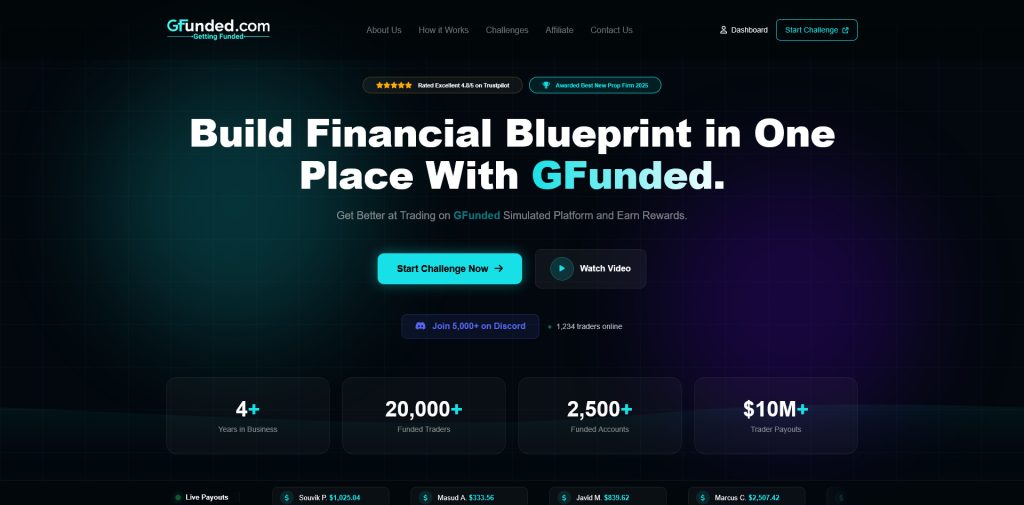
GFunded has emerged as a game-changer in the trading world. The prop firm now supports over 400,000 funded traders and has paid more than $10M to its community. Their impressive 4.8/5 Trustpilot rating caught our attention, so we tested their challenges ranging from $5K to $400K.
Our tests showed that GFunded uses simulated accounts. Traders must pass an evaluation before they get real funding. The firm's entry prices range from $95 to $925 for account sizes between $10,000 and $200,000. Profit splits can reach up to 85%, making the platform available to traders of all experience levels. The rules are simple - traders need to hit a 10% profit target while staying within a 4% daily loss limit and 6% maximum loss. There's no time pressure to achieve these targets.
This review dives deep into GFunded's evaluation processes, account types, trading platforms and payout procedures. Our hands-on experience will help you decide if GFunded matches your trading goals, whether you're just starting out or you're a professional trader looking for more capital.
Prop trading firms like GFunded have transformed how traders get into capital markets. These firms let traders use substantial trading capital without risking their own savings. The path to success depends on your trading skills rather than personal wealth.
GFunded works through a step-by-step progression model. Traders start with an "evaluation phase" or "challenge" where they trade in a 100% simulated environment with no real capital at risk. This phase lets you show your trading skills and risk management abilities.
The next step makes this model exciting. Once you pass the evaluation, you get a "CASH funded account." You still trade in a simulated environment, but your profits turn into real money. It creates an interesting setup - your trades don't hit live markets, but you get actual cash when you perform well.
The profit split is straightforward - traders keep 80% while the prop firm takes 20%. This setup helps skilled traders earn money while firms manage their risk. Some firms take it further and move their best traders to "LIVE funded accounts" that execute trades on exchanges through regulated brokers.
Modern prop trading has opened up capital access worldwide. You no longer need to be in traditional finance hubs to trade. Traders from over 100 countries can now use prop trading services like GFunded.
Some restrictions apply though. These firms can't work with:
These limits exist due to international laws, service provider rules, fraud prevention, and support capabilities. The best prop firms understand these challenges and offer multilingual platforms, multiple payout options, and round-the-clock support.
Prop firms and traditional brokers work in completely different ways. Traditional brokers make you trade with your own money. They might offer leverage, but you're still on the hook for any losses.
GFunded and similar prop firms take a unique approach. You just pay an evaluation fee based on account size and trade with simulated funds. Your risk is limited to this fee - not your entire position.
This creates an interesting trade-off. Brokers give you all profits minus commissions but make you eat all losses. Prop firms share profits (usually 80-90%) with successful traders and cover losing trades themselves. This changes how risk works and lets traders without big accounts use advanced trading strategies.
Prop firms make money through evaluation fees and their cut of profitable trades. This model helps them pay successful traders while managing risk, which creates opportunities for skilled traders who lack capital.
GFunded gives traders several ways to get funded trading accounts that work for different skill levels and goals. Each account comes with its own setup, rules, and perks. Let's get into the three main account types GFunded offers traders looking for capital backing.
The 1-Step Evaluation offers a quick path to funded trading. True to its name, traders only need to pass one test phase to access funded capital. This option cuts down the time to get funded status, which makes it perfect for traders who like things simple and quick.
Traders need to hit a profit target of about 10% while following the firm's risk rules. The best part? There's no time limit, so traders can work on their strategies at their own pace without rushing to meet deadlines.
What makes the 1-Step Evaluation stand out is its simple setup - show you can make consistent profits within the guidelines, and you'll move straight to funded trading. This setup works great for traders who already know what they're doing and just need to show their strategies work.
GFunded caps daily profits at 20% to keep trading disciplined. This helps prevent risky overtrading and rewards steady performance instead of lucky trades. On top of that, traders must trade for 3-5 days minimum to show their trading style is reliable.
The 2-Step Evaluation is what you'll find most prop trading firms use. It gives traders a slower path to funded status through two phases: an original challenge and a stage that confirms consistency.
The first phase usually needs an 8% profit target, while the second phase drops to 5%. This setup helps firms spot truly skilled traders from those who might just get lucky during a short evaluation.
The second phase keeps similar risk rules but runs longer to make sure traders can perform well in different market conditions. Success in both phases shows the firm the trader knows their stuff and can handle risk well.
This 2-Step model gives newer traders or those still working on their strategies more time to practice. They can build up their confidence and discipline step by step on their way to funded status.
GFunded's Instant Funding skips the evaluation process completely for experienced traders who want capital right away. You'll pay more upfront than with regular evaluations, but you get immediate access to a funded account.
These accounts let you start trading right away with no profit targets to hit first. The trade-off? Stricter risk rules and limits on position sizes to protect the firm's money while working with unproven traders.
Traders usually get 70% to 80% of the profits, which might be less than evaluation-based accounts because the firm takes on more risk. Some accounts even have a "smart drawdown" feature that protects your gains once you hit 5% profit.
Professional traders often find this option worth the higher cost because they value quick access to capital more than evaluation fees. They can start making money right away instead of spending time proving their skills through regular evaluations.
Your experience level, comfort with risk, and money goals should guide your choice between these accounts. Each option has its own benefits that might match your trading style and what you want to achieve.
Your success in prop trading depends on knowing how to master evaluation rules. These guidelines aren't random restrictions. They create a framework that identifies and rewards disciplined, consistent traders.
Prop firms set profit objectives between 6% to 15% of account value to verify your consistent returns. GFunded's evaluation models have different profit targets based on your challenge type. Their 1-Step Evaluation needs a 10% profit target without time limits. Their 2-Step Evaluation needs 8% profit in Phase 1 and 5% in Phase 2.
The minimum trading day requirements matter just as much. Most prop firms need between 3-7 trading days during evaluations, whatever your profit targets. To name just one example, see how some programs need at least 5 trading days even if you hit your profit goal early. This rule makes sure you pass based on strategy, not luck.
A single trade can qualify as a trading day - even a tiny 0.01 lot trade works. Some firms take it further and need a minimum profit like 0.5% of original balance to count as a qualifying day.
Daily loss limits act as vital guardrails against catastrophic trading disasters. These limits, usually 2% to 5% of account value, stop traders from chasing losses with desperate positions - a pattern that often leads to blown accounts.
Maximum drawdown rules protect firm capital by limiting account losses from peak value. These limits usually run from 4% to 10% of starting balance. Going past this limit fails your evaluation right away since it shows risk management problems.
Prop firms make a difference between two drawdown types. A static drawdown stays fixed below your starting balance. A trailing drawdown rises with your equity and locks at the highest point. You need to know which type applies to avoid breaking rules by mistake.
Lucky one-time trades shouldn't determine success. Many firms use consistency rules that limit how much profit can come from one day's trading. The industry standard sits at about a 20% consistency rule. No single day's profit should exceed 20% of your total profits.
This rule rewards balanced, methodical trading over gambling. Let's say you made $2,000 in profit across four days with your best day at $600. Your consistency percentage would hit 30% (600 ÷ 2000 = 30%). Since this goes over the 20% limit, you'd need more trading days to lower that percentage before getting paid.
The consistency percentage starts fresh after each payout. You'll need to stay consistent for your next payout cycle. This helps both traders and firms by encouraging smart risk management and avoiding risky trades that might work once but crash later.
You should really understand these rules before your first trade. Most traders fail prop firm challenges because they break rules, not because their strategy fails. Think of these rules as protective guidelines rather than roadblocks, and you'll boost your chances of a soaring win.
Success in prop firm challenges depends on knowing drawdown types. The ever-changing world of prop trading defines drawdown as the maximum money you can lose from your account balance. Prop firms use different drawdown rules, but static and trailing drawdown are the two main types.
Static drawdown, also known as fixed drawdown, sets a specific amount or percentage of your original account balance you cannot exceed. This limit stays the same whatever profits you make during your trading trip.
Let's say you start with a $100,000 account and the prop firm sets a static drawdown limit of $5,000. Your account balance should not drop below $95,000 at any point during the challenge. The best part about static drawdown is that this threshold does not change even if your account grows by a lot.
To cite an instance, your drawdown limit stays at $95,000 even when your account balance grows to $120,000. Your profits give you more room to breathe and flexibility in your trading decisions.
Static drawdown's biggest advantage is that you can predict it. You know your stop-out level, which makes planning your risk management strategy easier. Note that static drawdown gives you a steady risk limit that does not change with account growth.
Trailing drawdown works differently because it adjusts based on your trading performance. It creates a moving threshold that follows your equity peaks but never drops when your account balance falls.
Two main types of trailing drawdown exist:
End-of-Day (EOD) Trailing Drawdown: This updates only when trading day ends, based on your closed positions. Your new drawdown limit would rise to $105,000 if your account grows from $100,000 to $110,000 by day's end (assuming a $5,000 trailing amount).
Intraday Trailing Drawdown: This updates with up-to-the-minute data analysis based on your highest floating equity, including unrealized profits. This type challenges traders more because your drawdown limit can increase during the day based on unrealized profits that might shrink later.
Here's an example: With a $100,000 account and $5,000 trailing drawdown, your drawdown limit adjusts to $105,000 if your highest balance hits $110,000. Your balance cannot fall below $105,000 without breaking the drawdown rule.
The vital difference is that trailing drawdown moves up as your account grows but never moves down, even when your balance drops. This protects profits and encourages disciplined trading.
Your trading style and risk tolerance determine whether static or trailing drawdown works better for you.
Static drawdown helps:
Trailing drawdown benefits:
Trailing drawdown requires more discipline because it rewards profit protection and punishes giving back gains. Static drawdown offers more mental comfort since your risk parameters stay the same after profitable trades.
These differences help you pick the drawdown type that matches your trading method and priorities, which boosts your chances of success in prop firm challenges.
Prop firms give traders capital allocation options that match their trading styles and experience. GFunded's account sizes match industry standards. They range from basic $5K accounts to large $400K portfolios with unique pricing and terms.
Account size and evaluation type determine GFunded's evaluation fees. Standard evaluation accounts start at $39 for smaller accounts and go up to $1209 for larger capital allocations. This pricing structure makes funding available to traders at all levels.
The firm has three main evaluation models with different prices:
Professional traders can get bigger accounts through special programs. Some prop firms give up to $800K through scaling programs. Others let you access $300K accounts with monthly subscriptions starting at $147-$167.
Standard evaluation plans include both challenge and verification phases in the purchase fee. You won't pay extra between evaluation stages, unlike other firms that charge for each phase separately.
GFunded's model lets you get your evaluation fees back. You become eligible for a fee refund after passing both phases and becoming a funded trader. Here's how the refund works:
You get your evaluation fee back with your first profit withdrawal after meeting all requirements. This applies to challenge account fees you paid during registration.
Each account type has its own refund timeline:
Refunds process along with regular payouts, so there's no extra wait. You won't get a refund if you don't reach your first withdrawal. This motivates traders to stay disciplined.
The best traders sometimes break trading rules or hit drawdown limits. GFunded lets you reset your evaluation without buying a new account.
A reset brings your account back to its original balance and settings while keeping the same account number. This costs less than starting fresh, helping traders who need another chance.
Reset features include:
Some firms give free resets with monthly renewals if the account has failed. This helps traders save money while continuing their trading experience.
These pricing structures, refund policies, and reset options help you pick the right account size for your trading skills and budget.
Your choice of trading platform can make or break your success with prop firms. My testing revealed that GFunded gives you three different trading platforms, each with its own benefits for funded traders.
TradeLocker brings a fresh take on trading through its web-based interface that needs no downloads. The platform combines next-gen forex trading with TradingView charts to give you detailed market analysis. We designed it to be fast and simple, so you can trade smoothly on both desktop and mobile.
TradeLocker stands out because of its built-in risk management tools. You can set stop losses before entering positions and see your exact risk level, which helps you stay within GFunded's strict drawdown limits. These features are a great way to get better control when you manage multiple positions in different markets.
The platform lets you execute trades right from your charts, making everything faster and more precise. This creates a smoother workflow than old-school platforms that keep charting and order placement separate.
MatchTrader comes with free TradingView charts built right in. Forex industry experts developed this standalone technology in-house, and it can handle thousands of accounts with maximum efficiency.
The platform looks like a native app but runs in your browser and adjusts to fit your screen perfectly. You'll get the same trading experience on any device you choose to use.
MatchTrader automatically translates into multiple languages and lets prop firms add their logos and names. This creates a seamless connection between the platform and the firm.
Devexperts created DXTrade as a trading platform that works with multiple assets and markets. The platform uses fewer system resources than others and offers mobile apps for both Android and Apple devices.
Traders can pick from different asset classes, including futures and options, to spread risk and use hedging strategies. DXTrade helps prop traders by calculating margins for complex portfolios in real time, supporting both equity and futures trading.
The platform's accessible interface works well for beginners while giving experienced traders the tools they need. However, it can't handle algorithmic trading or multi-screen setups.
Your platform's stability affects how well you meet GFunded's evaluation requirements. Even tiny differences in execution speed can affect your trading profits, market liquidity, and overall results.
Platform freezes, disconnections, or delays can turn well-planned trades into rule violations. A delayed stop loss during market volatility could lead to bigger losses and break daily loss limits.
Prop firms usually make traders take responsibility for technical problems, no matter what caused them. This makes platform reliability crucial for managing risk, not just a nice-to-have feature.
Stable platforms give you predictable execution, which helps you stay consistent during prop firm evaluations. Quick execution becomes crucial for managing risk when markets get volatile, especially when you need to set stop-loss orders to limit potential losses.
Getting your profits is the final step in your prop firm experience with GFunded. You need to know the payout process and KYC requirements to turn your trading success into real income quickly.
Your consistent profits make requesting a payout through GFunded's dashboard easy. Standard accounts need a minimum withdrawal of $250, while expert accounts require $1000. You must meet all trading requirements like minimum trading days and profit targets before your first withdrawal request.
Different firms have varying payout processing times. Some approve requests the same day, others need 1-3 business days. Your funds will arrive in 5-11 business days based on your payment method.
You can choose between bank transfers (ACH, Wire, SWIFT) and cryptocurrency transactions. International wire transfers need 5-10 business days, while domestic ACH transfers complete in 1-3 business days. Your withdrawal amount will have processing fees ($30 for ACH/Wire) and profit splits.
Prop firms require KYC verification before your first payout. This step confirms your identity and protects everyone from fraud. Most firms use secure verification services like Veriff, Sumsub, or Rise.
Standard KYC requirements include:
KYC verification takes 24-72 hours. First payouts might take longer since they need complete KYC approval and contract signing. Your legal name should match on all documents and your trading account.
Your account's drawdown limits change when you withdraw profits. Many prop firms lock your maximum loss limit at your starting balance plus a small buffer ($100 in many cases) after your first payout. Traders call this the "drawdown rebase effect."
A $100,000 account growing to $120,000 with a $16,000 withdrawal would leave $104,000 in balance. Your drawdown limit stays at $100,000, giving you only a $4,000 buffer before breaking rules.
Some firms have special policies for multiple successful withdrawals. After two payouts from one account, certain firms reset your minimum loss limit. This increases your maximum withdrawal from 50% to 80% of profits. The reset gives you more room for future trades.
Trading firms set clear boundaries between allowed and forbidden strategies to keep markets fair. GFunded strikes a balance between flexibility and the rules needed for environmentally responsible trading.
GFunded allows reasonable scalping, but traders should hold positions longer than 2 minutes on average. Expert Advisors (EAs) work well on the platform, but they need stop-loss protection unless you buy a special add-on. News trading gets the green light with some limits - you should avoid entering trades 2-4 minutes before and after major economic announcements.
Some strategies are completely banned from every account type. High-Frequency Trading (HFT) uses complex algorithms for super-fast trades, and it's not allowed at all. Price arbitrage between markets creates artificial price movements, so traders can't use it. Copy trading between accounts hurts evaluation fairness, just like Martingale strategies that boost position sizes after losses. Grid trading and sharing accounts break the standard rules too.
Risk management rules say you must set stop-losses within 5 minutes after opening a trade. Your maximum risk per position can't go above 3% of your original account balance. The platform requires at least one trade every 21-30 days to keep your account active. Breaking these rules usually means your account gets closed without notice.
GFunded is a great option for traders who want capital without putting their own money at risk. We tested their challenges from $5K to $400K and found their model helps both new and experienced traders. Their evaluation process is tough but gives you a clear path to get large trading capital with profit splits up to 85%.
GFunded's flexible approach to trader growth sets them apart. You can pick from three account types - 1-Step Evaluation, 2-Step Evaluation, and Instant Funding based on your experience and needs. On top of that, their simple rules about profit targets, drawdown limits, and trading requirements tell you exactly what you need to succeed.
Your choice between static and trailing drawdown is vital when picking a challenge type. Static drawdown works best for swing traders who want steady parameters. Day traders who want to protect their profits should go with trailing drawdown. Your chances of passing evaluations go up by a lot when you match your trading style to the right drawdown type.
The platform choices - TradeLocker, MatchTrader, and DXTrade - fit different trading priorities well. Good execution quality is vital when you manage positions under strict risk rules. It makes sense to test your preferred platform before you move to bigger account sizes.
The payout process deserves a close look. GFunded's KYC requirements are standard for the industry, but first-time withdrawals might take extra time for verification. You should pay special attention to how drawdown rebase works after withdrawals since it changes how flexible your future trading can be.
Traders looking for real funding opportunities will find GFunded's package appealing. The evaluation fees are reasonable and you get them back when you succeed. Their limits on certain trading strategies show they want long-term traders instead of people trying to exploit quick market gaps.
GFunded's impressive 4.8/5 Trustpilot rating shows they keep their promises to traders. You can start with a small $5K challenge or go big with a $400K account. This prop firm gives you the strong support you need to turn your trading skills into real income without risking your own money.
After testing GFunded's challenges from $5K to $400K, here are the essential insights every trader should know:
• GFunded offers three pathways to funding: 1-Step Evaluation (direct route), 2-Step Evaluation (gradual approach), and Instant Funding (immediate access for experienced traders)
• Evaluation fees are refundable after successful completion: Fees range from $39-$1209 depending on account size, with refunds issued after your 3rd-5th payout
• Understanding drawdown types is crucial for success: Static drawdown provides consistent limits ideal for swing traders, while trailing drawdown suits day traders protecting accumulated profits
• Risk management rules are straightforward but strict: 10% profit target, 4% daily loss limit, 6% maximum drawdown, with mandatory stop-losses within 5 minutes of trade entry
• Platform variety supports different trading styles: TradeLocker for speed, MatchTrader with built-in TradingView charts, and DXTrade for multi-asset trading
• Profit splits reach up to 85% for traders: With over $10M paid out to 400,000+ funded traders, GFunded demonstrates legitimate payout capability and sustainable business model
The firm's 4.8/5 Trustpilot rating reflects its commitment to providing accessible funding opportunities without requiring personal capital risk, making it suitable for both novice and professional traders.
Q1. What are the main account types offered by GFunded? GFunded offers three primary account types: 1-Step Evaluation for a direct route to funding, 2-Step Evaluation for a more gradual approach, and Instant Funding for experienced traders seeking immediate access to capital.
Q2. How does GFunded's refund policy work? GFunded's evaluation fees are refundable upon successful completion of the challenge. Refunds are typically issued after the 3rd payout for 1-Step and 2-Step Evaluations, and after the 5th payout for Instant Funded accounts.
Q3. What are the key differences between static and trailing drawdown? Static drawdown maintains a fixed limit regardless of account growth, suitable for swing traders. Trailing drawdown adjusts based on account peaks, better suited for day traders focused on protecting accumulated profits.
Q4. What trading platforms does GFunded provide? GFunded offers three main platforms: TradeLocker for speed and simplicity, MatchTrader with built-in TradingView charts, and DXTrade for multi-asset trading across various markets.
Q5. What are the profit split percentages for successful traders at GFunded? GFunded offers competitive profit splits, with successful traders able to earn up to 85% of their trading profits. This high percentage reflects the firm's commitment to rewarding skilled traders.
A forex no deposit bonus is promotional trading credit a broker adds to a new live account without asking you to deposit money first. You trade real market prices with it, and profits become withdrawable once you meet the broker's conditions.
Usually the bonus credit itself cannot be withdrawn. The profit you make with it can be, after you complete the required trading volume, verification and any minimum activity rules. Most brokers also cap the maximum profit you can cash out.
It costs you no money, but it is not unconditional. You pay with time, identity verification and trading volume. Read the terms so you know the lot requirement, expiry date and withdrawal cap before you place a trade.
It is a customer acquisition tool. Brokers let you test their platform, execution and support at no cost, hoping you will become a funded client later.
Almost always. Most offers require a verified identity document and proof of address, and some also verify your phone number. Verification protects the broker from duplicate accounts.
Realistic results are modest. Withdrawal caps commonly range from a few dozen to a few hundred dollars. Treat the bonus as a low-risk way to build skill and test a broker, not as a source of large income.
You can claim offers from different brokers, but each broker normally allows only one bonus per person, household, IP address or device. Opening duplicate accounts usually voids the bonus and any profits.
A no deposit bonus requires no funding and is small. A deposit bonus is a percentage added on top of money you deposit, so it can be larger but puts your own capital at risk.
Tell us your bonus or promotion FOR FREE. It is easier than you think!